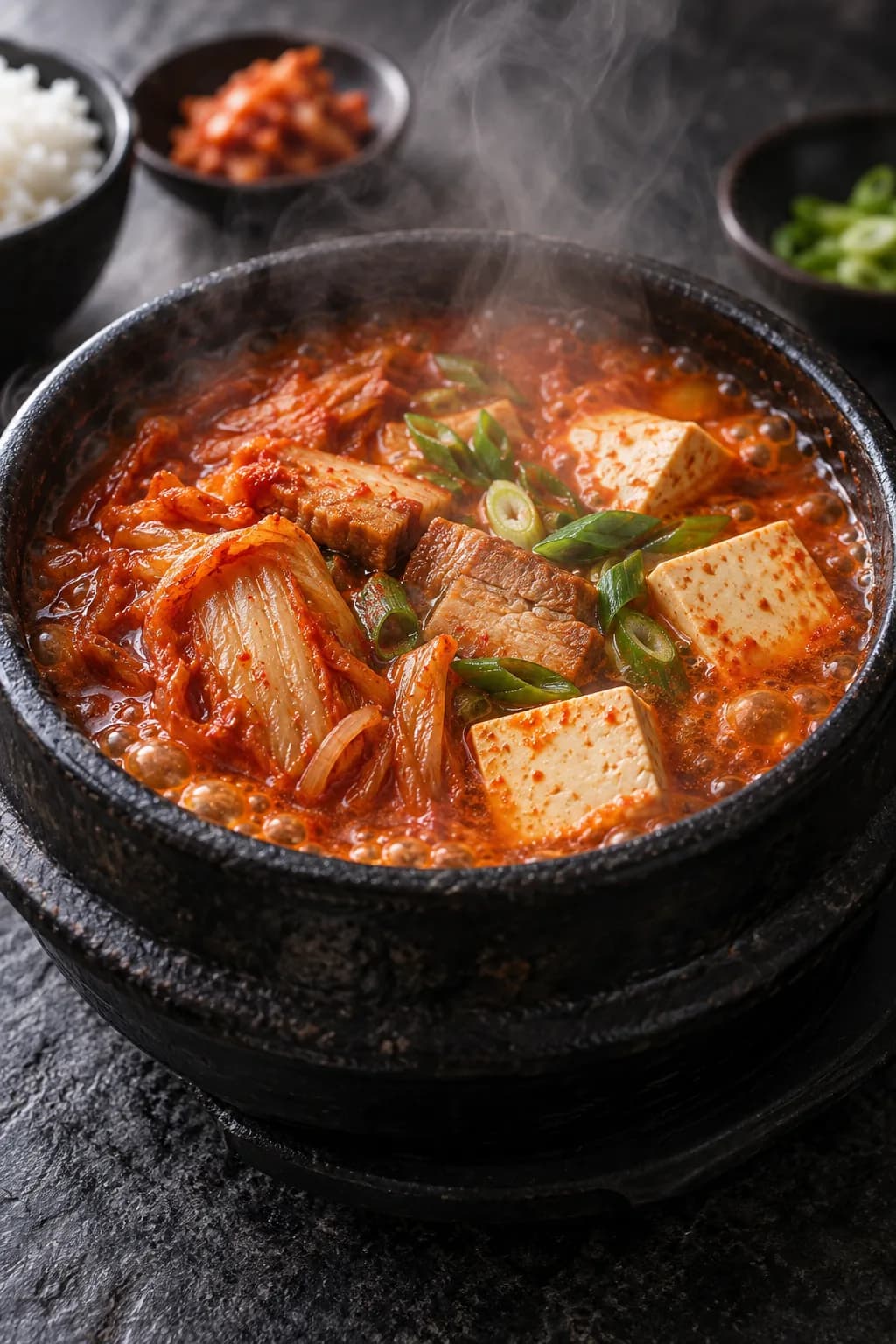
Kimchi jjigae (김치찌개) is the answer to a question every Korean household eventually faces: what do you do with kimchi that has fermented past the point of eating it raw?
You cook it. Specifically, you simmer it with pork fat and water until the sourness turns into depth, add tofu so there is something soft against the heat, and eat it over rice. That is the whole dish. It takes about twenty minutes once the kimchi is in the pot, and it is on Korean tables more often than almost anything except the kimchi itself.
The word jjigae means stew — thicker and saltier than a guk (soup), served in the pot it was cooked in, meant to be eaten with rice rather than drunk on its own. Kimchi jjigae is the most common jjigae there is. Doenjang jjigae (soybean paste stew) and sundubu jjigae (soft tofu stew) are its siblings; this one is the default.
Why it only works with old kimchi
This is the point most recipes written outside Korea get wrong, and the reason a first attempt often tastes flat and oddly sweet.
Fresh kimchi — a few days old, still crunchy, tasting mainly of salt, garlic, and raw chili — has not developed the lactic acid that gives jjigae its backbone. When you simmer fresh kimchi, you get boiled cabbage in chili water. The sourness is what turns into savory depth over heat, the same way wine reduces into a sauce.
Kimchi that is right for jjigae is at least two to three weeks into fermentation, and better at a month or more. Koreans call this shin kimchi (sour kimchi) or, when it is really far gone, mugeunji (aged kimchi, often a year old). The cabbage has softened, the liquid has turned cloudy and sharp, and the smell has moved from fresh to pungent. That is the ingredient. If your kimchi still snaps when you bite it, it is not ready to become stew.
A practical test: taste the kimchi liquid. If it makes you wince slightly, it is right. If it tastes like a pleasant salad, wait — or add a teaspoon of rice vinegar to the pot, which is a fair emergency substitute for fermentation time.
Store-bought kimchi in a sealed jar ferments slowly in the refrigerator. Leave the jar at room temperature for a day or two to move it along, then refrigerate again. The pressure that builds is normal; open it over the sink.
The two families: pork and tuna
Kimchi jjigae is built on fat, because the fat carries the kimchi's chili and rounds the acid. Where that fat comes from defines the version.
Pork belly (돼지고기 김치찌개) is the classic. Sliced pork belly is rendered in the pot first, the kimchi is fried in the pork fat until it starts to caramelize at the edges, and only then does the water go in. This is the version served at restaurants and the one most Koreans mean when they say kimchi jjigae without qualification. The broth ends up glossy and rich.
Canned tuna (참치 김치찌개) is the student and late-night version: a can of tuna in oil, oil and all, stirred in near the end. It is faster and lighter, and it was the first thing many Koreans learned to cook for themselves. Not a compromise — a different dish with a different fan base.
Less common but legitimate: spam (which overlaps with budae jjigae territory), mackerel, or no meat at all with extra tofu and a spoon of doenjang for body.
Whichever you choose, the tofu is not optional. Soft or medium-firm tofu, cut into thick slabs, goes in for the last five minutes. It does not add flavor. It adds relief.
The step that matters: fry the kimchi first
Most of the flavor in a good kimchi jjigae comes from about four minutes at the start that many home cooks skip.
After the pork belly has rendered, add the kimchi and a spoon of its liquid to the pot and let it cook in the fat over medium-high heat, stirring occasionally, until the edges begin to brown and the smell changes from sharp to sweet. The sugars in the cabbage and the chili paste are caramelizing. The acidity is mellowing. If you add water before this happens, you are boiling; if you add it after, you are building a stew on a browned base, the same logic as searing before braising.
A teaspoon of sugar at this stage is traditional in many households — not to make the stew sweet but to balance kimchi that has gone very sour. Taste your kimchi and decide.
The ratio
For four servings, this is the proportion that keeps the broth concentrated enough to eat with rice rather than thin enough to drink.
- 400 g aged kimchi, cut into 3 cm pieces, plus 4 tablespoons of its liquid
- 200 g pork belly, sliced 5 mm thick
- 1 tablespoon gochugaru
- 1 teaspoon gochujang (optional — some households use none)
- 1 tablespoon soy sauce or fish sauce
- 1 teaspoon sugar, if the kimchi is very sour
- 500 ml water, or anchovy-kelp stock if you have it
- 300 g soft or medium tofu, cut into thick slices
- 2 scallions, cut on the diagonal
- 1 teaspoon toasted sesame oil, to finish
Method. Render the pork in a heavy pot over medium heat until the fat runs, 4–5 minutes. Add the kimchi and its liquid; fry 4 minutes until the edges caramelize. Stir in gochugaru, gochujang, soy sauce, and sugar. Add the water, bring to a boil, then simmer uncovered 12–15 minutes so the broth reduces slightly and turns a deep red. Lay the tofu on top, cover, simmer 5 minutes more. Scatter the scallions and finish with sesame oil. Serve in the pot, with rice.
The stew should look thicker than a soup and taste noticeably salty on its own — it is seasoned to be eaten with plain rice, which dilutes it. If you taste it alone and it seems perfect, it will be under-seasoned on the table.
A full, tested version is on the free recipe page: Kimchi Jjigae, built around mugeunji.
What it is not
Kimchi jjigae is often confused with three neighbors.
Budae jjigae ("army stew") starts from a similar kimchi-chili base but adds spam, sausage, instant ramyeon, baked beans, and sliced cheese — a postwar dish built from American base surplus. Louder, larger, eaten communally from a wide pan.
Sundubu jjigae is soft tofu stew: the tofu is the main event, unpressed and custard-soft, with a smaller amount of kimchi or none, often with an egg cracked in at the table.
Kimchi guk is the soup version — thinner, more water, less pork, served in individual bowls.
If the pot is small, red, thick, and mostly kimchi and pork, it is kimchi jjigae.
Serving it
Rice is not a side; it is half the dish. A bowl of short-grain white rice per person, the stew in the center, spoons for both. Two or three banchan complete it — something mild and sesame-dressed like spinach namul, something crisp like cucumber, and, yes, a small dish of fresh kimchi, because the contrast between the raw and the cooked versions on the same table is the point.
Leftover kimchi jjigae is better the next day. The tofu firms up slightly and the broth deepens. Reheat gently and add a splash of water if it has tightened.
Where it sits in the Borderless Kitchen logic
Kimchi jjigae is a lesson in what fermentation does under heat. The acid that makes old kimchi hard to eat raw becomes, after a few minutes in pork fat and twenty minutes in water, the most savory thing on the table. The same principle runs through Italian cooking — sour wine reduced into a pan sauce, aged cheese melted into pasta water — and it is why the kimchi-and-pork base of this stew moves so naturally into the tomato-and-guanciale world in Seoul Meets Mexico City and the pasta chapters of Tokyo Meets Tuscany.
Start here, with the stew as Korea makes it. The fusion versions only work once you know why the kimchi has to be old.
From the pantry
Free recipes from this world
Related reading
The full recipes live in the book.
Get Seoul Meets Mexico City on AmazonAs an Amazon Associate we earn from qualifying purchases. This is an affiliate link — it costs you nothing extra.
Paperback $19.99 · Kindle $9.99