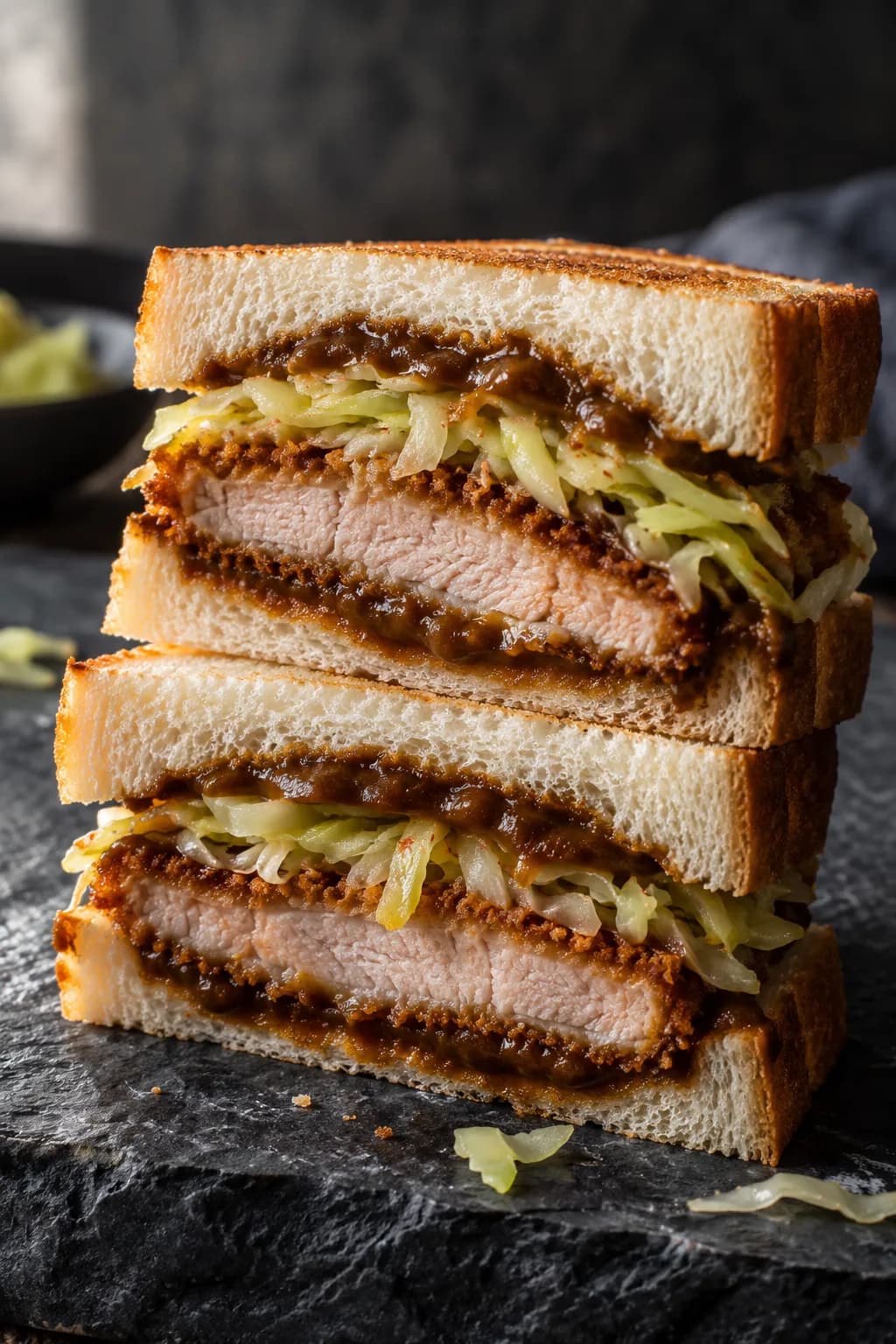
There is a specific kind of sandwich that exists only in Japan — the katsu sando. It is sold wrapped in plastic in every convenience store, every bento shop, every train station kiosk. It does not look like much through the cellophane. What you find inside is something structurally unlike anything in the Western sandwich tradition: shatteringly crispy panko-breaded pork cutlet pressed between two slices of pillowy, slightly sweet Japanese milk bread (shokupan), with nothing but Bulldog sauce and maybe some shredded cabbage between them.
The contrast is the thing. The panko crust on tonkatsu is not like any Western breading. It is lighter, more open-structured, crispier, and louder. It shatters when you bite through it. The milk bread yields completely — it is soft almost to the point of being fragile. The two meet in the middle in a way that no other bread-filling combination quite replicates.
This version adds Japanese curry sauce — the thick, slightly sweet, deeply savory sauce made from S&B Golden Curry roux — and quick-pickled cabbage for acid and crunch. The curry sauce acts as a spread, rich enough to hold the sandwich together. The pickled cabbage cuts through the richness of the fried pork. It is, by any measure, a better sandwich than the convenience store original. It takes about 30 minutes.
Ingredients
The tonkatsu:
- 2 boneless pork loin chops, about 2cm thick (approximately 150g each)
- Salt and freshly ground black pepper
- 3 tablespoons all-purpose flour
- 1 egg, beaten
- 1 cup panko breadcrumbs — do not substitute regular breadcrumbs
- Neutral oil for frying (about 250ml — enough for 1cm depth in the pan)
The curry sauce:
- 1 block S&B Golden Curry roux (medium or hot — your preference)
- 300ml water (slightly less than package directions — you want a thick, spreadable consistency)
The quick-pickled cabbage:
- 1 cup green cabbage, very thinly shredded
- 2 tablespoons rice vinegar
- 1 teaspoon sugar
- 1/2 teaspoon salt
- 1 teaspoon sesame oil
- Optional: pinch of togarashi or chili flakes
The sandwich:
- 4 slices Japanese milk bread (shokupan) — or the softest, most pillowy white sandwich bread you can find; brioche is an acceptable upgrade
- Optional: 1 tablespoon Japanese mayonnaise (Kewpie) spread on one side
Method
Make the pickled cabbage first (it needs at least 10 minutes to soften).
1. Quick-pickle the cabbage. Combine rice vinegar, sugar, and salt in a medium bowl. Stir until the sugar and salt dissolve. Add the shredded cabbage and toss to coat. Add the sesame oil. Set aside at room temperature. Toss every few minutes. By the time the tonkatsu is done, the cabbage will have softened slightly and absorbed the dressing.
2. Make the curry sauce. In a small saucepan, bring 300ml of water to a simmer. Break one block of S&B Golden Curry roux into pieces and add it. Whisk over medium-low heat until completely dissolved and smooth, 2-3 minutes. The sauce should be noticeably thicker than you'd normally make for curry over rice — it should coat a spoon heavily and hold its shape briefly when you drag a line through it. If it seems too thin, simmer for another 2-3 minutes, stirring constantly. Remove from heat. Set aside to cool slightly.
3. Prepare the pork. Place each pork chop between two sheets of plastic wrap or in a zip-lock bag. Using a meat mallet or the bottom of a heavy pan, pound to approximately 1cm thickness. Work from the center outward. The goal is even thickness — not paper-thin, but significantly thinner than you started. Season both sides generously with salt and pepper.
4. Set up the breading station. Three shallow bowls: flour in the first, beaten egg in the second, panko in the third. Season the flour lightly with salt.
Dredge each pork chop in flour, shaking off the excess. Dip in egg, letting the excess drip off. Press firmly into the panko, turning and pressing to build a thick, even coating that adheres on all sides. Press hard — you want the panko to compact slightly into the surface. Set aside on a plate.
5. Fry the tonkatsu. Pour neutral oil into a wide, heavy pan to a depth of about 1cm. Heat over medium-high until a piece of panko dropped in sizzles immediately and floats — approximately 170°C. Do not let the oil smoke heavily.
Carefully lower the breaded pork into the oil. Fry undisturbed for 3-4 minutes until the bottom is deep golden brown. Flip carefully and fry another 3-4 minutes. The crust should be a rich amber-brown — not pale gold, not dark. The internal temperature should reach 63°C (145°F).
Transfer to a wire rack (not paper towels — paper towels trap steam and soften the bottom crust). Rest for 2 minutes. Slice each cutlet in half crosswise.
6. Assemble. Spread a generous layer of curry sauce on one side of each bread slice — use more than you think is right. If using Kewpie, spread it on the other sides. Lay the quick-pickled cabbage on two of the slices (drain briefly). Place the sliced tonkatsu on top of the cabbage, cut side facing inward. Press the other bread slice on top firmly.
For the classic katsu sando presentation: trim all four crusts with a sharp knife. Cut the sandwich in half — straight across, not diagonal.
Serve immediately. The panko crust will soften as it sits, absorbing moisture from the curry sauce. This sandwich does not hold. Eat it within 10 minutes of assembly.
Notes
On the bread: Japanese shokupan (milk bread) is the correct choice and worth seeking out at an Asian grocery. It is softer, slightly sweeter, and more pillowy than any Western sandwich bread. If unavailable, look for brioche sandwich loaves, Hawaiian rolls (if you're assembling individually), or any white sandwich bread that compresses easily without tearing. Sourdough is the wrong choice here — the tang and chew fight the sandwich.
On the curry roux: S&B Golden Curry is available at most supermarkets with an international aisle and at any Asian grocery. The mild version is noticeably sweet; the hot version has real heat. Vermont Curry (made by House Foods) is slightly sweeter still, with apple and honey notes, and also works well here. Do not make scratch curry for this recipe — the roux-based sauce has a specific texture and sweetness that is exactly right as a spread.
On the oil temperature: 170°C is significantly lower than you might expect for frying. This is intentional. The pork is thin and will overcook quickly at higher temperatures. The slightly lower temperature gives you more control and produces a more evenly golden crust rather than dark outside, pink inside.
On leftovers: tonkatsu reheats reasonably well in an oven at 200°C for 8-10 minutes. The assembled sandwich does not reheat. Fry the pork fresh for the best result.
30 recipes and 6 master sauces in the book.
Get Tokyo Meets Tuscany on AmazonAs an Amazon Associate we earn from qualifying purchases. This is an affiliate link — it costs you nothing extra.
Paperback · Kindle