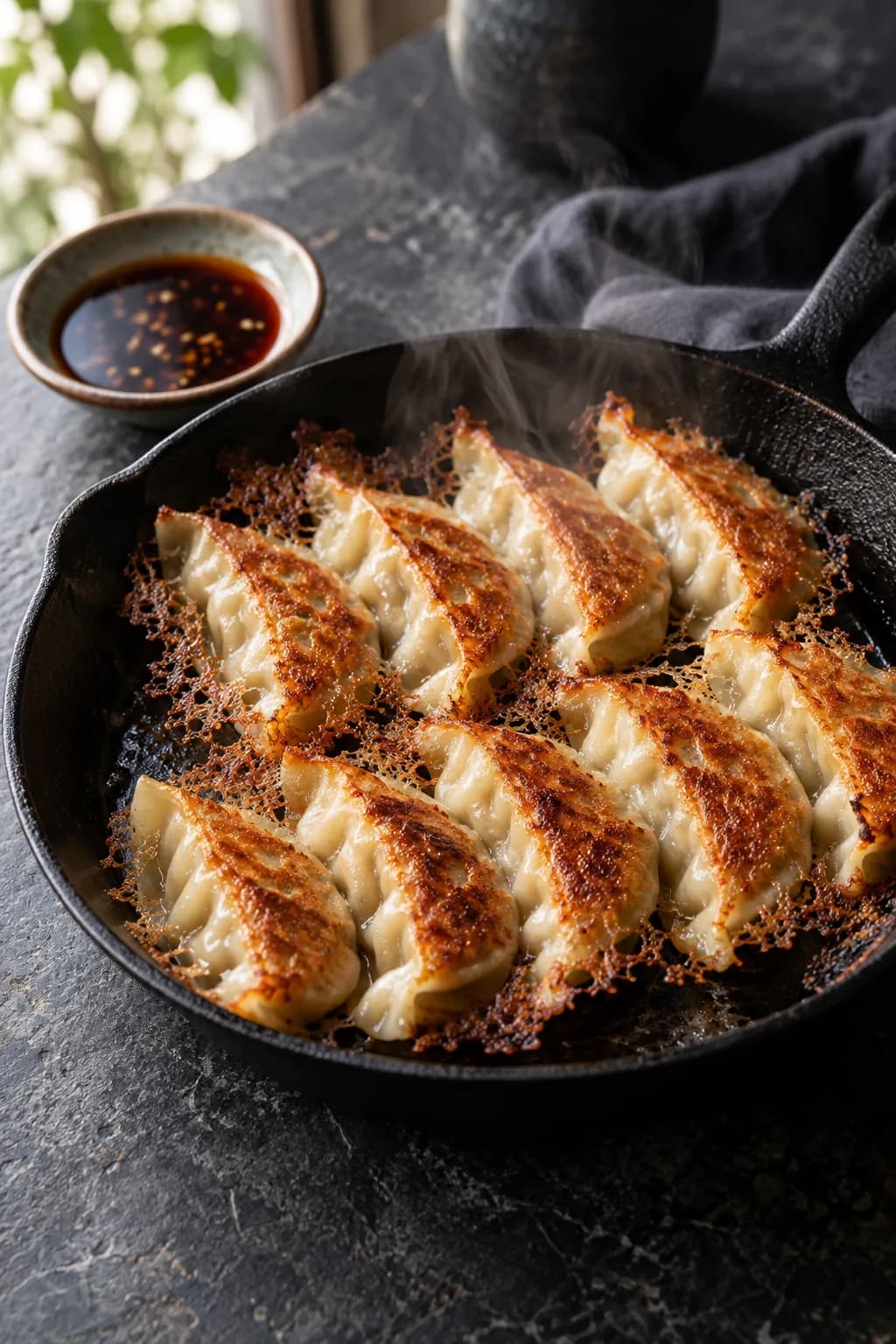
Are gyoza Japanese or Chinese?
The honest answer is both, and the question is worth asking properly because the differences are real and specific. Gyōza (餃子) is simply the Japanese pronunciation of the same characters the Chinese read as jiǎozi. The dumpling arrived in Japan in the early twentieth century and became a national dish after 1945, when soldiers returning from Manchuria brought the technique home and opened cheap restaurants to feed a hungry country. Utsunomiya, north of Tokyo, still claims the highest gyoza consumption in Japan on the strength of that history.
What Japan did next is the interesting part. Over about two decades, the dumpling was reshaped to fit Japanese ingredients, Japanese eating habits, and a specific place at the table. The result is close enough to its parent to share a name and different enough that a cook needs to know which one they are making.
The wrapper
Chinese jiaozi wrappers are thicker — often hand-rolled from a plain flour-and-water dough, with a slightly chewy body that stands up to boiling. A boiled dumpling with a thin skin bursts; the thick skin is functional.
Japanese gyoza wrappers are thin, usually machine-made, and sold in stacks of round sheets that are noticeably more translucent. Thinness is the point: the dumpling is going to be pan-fried, and a thin skin crisps on the bottom and turns delicate on top. Japanese cooks almost never make gyoza wrappers from scratch. The packaged sheets are the standard, not a shortcut.
If you use Chinese wrappers for pan-fried gyoza, the bottoms crisp fine but the tops stay doughy. If you boil Japanese wrappers, they tear. Match the wrapper to the method.
The filling
Both use ground pork and cabbage as the base. The divergence is in the aromatics.
Chinese jiaozi fillings vary enormously by region — pork and Chinese chive, lamb and cumin in the northwest, pork and napa cabbage, shrimp and egg — and are typically seasoned with soy, Shaoxing wine, ginger, white pepper, and sesame oil. Garlic is present in some regions and absent in others.
Japanese gyoza fillings are far more standardized: pork, cabbage (often salted and squeezed first), nira (garlic chives), ginger, and a large amount of garlic. The garlic is what people notice. Japanese gyoza are pungent in a way most Chinese dumplings are not, and the classic gyoza-and-beer pairing depends on it.
The other consistent difference is texture. Japanese fillings are usually finer — the cabbage is chopped smaller, the pork is mixed until sticky — producing a more uniform, almost pâté-like interior. Chinese fillings tend to be coarser and juicier, sometimes with added stock or aspic to create soup inside.
The cooking method
This is the biggest split.
Chinese jiaozi are boiled by default (shuǐjiǎo, water dumplings). Steaming is the second most common method. Pan-frying exists — guōtiē, "pot-stickers," are the direct ancestor of Japanese gyoza — but it is one option among several, and guotie are often shaped differently, left open at the ends.
Japanese gyoza are pan-fried by default — yaki-gyoza. So much so that "gyoza" without a qualifier means the fried version. Boiled gyoza (sui-gyoza) and deep-fried (age-gyoza) exist but are the exceptions.
The Japanese pan-fry is a specific technique, sometimes called fry-steam:
- Heat a tablespoon of neutral oil in a lidded non-stick or carbon-steel pan over medium-high heat.
- Arrange the gyoza flat side down, touching, in a row or a circle. Fry 2 minutes until the bottoms are golden.
- Pour in about 80 ml of water (for a 24 cm pan), cover immediately, and steam 3–4 minutes until the water has nearly gone and the tops are translucent.
- Uncover, add a teaspoon of toasted sesame oil around the edge, and fry another minute until the bottoms are crisp and the pan is dry.
- Invert onto a plate so the crisp side faces up.
The restaurant refinement is hanetsuki gyoza — "winged" gyoza — where a teaspoon of flour or cornstarch is whisked into the steaming water. As the water evaporates, the starch fries into a lacy sheet connecting the dumplings. This is a Japanese invention with no Chinese equivalent.
The dipping sauce
Chinese jiaozi are most often dipped in black vinegar (Chinkiang), sometimes with julienned ginger, sometimes with chili oil, and often with no soy sauce at all — vinegar is the dominant note.
Japanese gyoza sauce is tare built from soy sauce and rice vinegar in roughly equal parts, plus a few drops of rāyu (chili oil). Soy leads, vinegar supports. Some regions add a spoon of grated garlic or a shake of shichimi togarashi. The soy-forward sauce suits the garlic-heavy filling and the beer.
The place at the table
The deepest difference is not in the dumpling but in what it is for.
In northern China, jiaozi are a meal. A family makes them together by the dozen, boils them, and eats them by the plateful — the food of Lunar New Year and of any occasion that needs a crowd fed. Fifteen or twenty per person is normal.
In Japan, gyoza are a side dish. The classic order is a bowl of ramen with a plate of six gyoza and a beer, or a set meal of rice, miso soup, and gyoza. Gyoza restaurants exist, but even there, a serving is six to twelve. The dumpling became a supporting player, and its size, seasoning, and cooking method all reflect that: small, intensely flavored, crisp enough to hold up next to a bowl of hot broth.
Quick reference
| | Chinese jiaozi | Japanese gyoza | |---|---|---| | Wrapper | Thicker, often hand-rolled | Thin, machine-made rounds | | Filling | Regional; garlic optional | Pork, cabbage, nira, heavy garlic | | Default cooking | Boiled (steamed second) | Pan-fried, fry-steam | | Sauce | Black vinegar-led | Soy-and-rice-vinegar tare with chili oil | | Role | The meal | Side dish with ramen or rice | | Serving | 15–20 per person | 6–12 per person |
Which one should you make?
If you want dumplings as the meal, with a thick, chewy skin and a juicy interior, make jiaozi and boil them. If you want a crisp-bottomed side to go with ramen, or something to eat with beer, make gyoza and pan-fry them — and buy the thin wrappers.
A complete gyoza method, including the cabbage-salting step that keeps the filling from going watery and the pleating technique, is in the Japanese Gyoza Guide. The same fry-steam technique, applied to a very different filling, is what makes the pork-and-kimchi mandu in Seoul Meets Mexico City work: it is not Chinese and not Japanese, but the pan does exactly what a Japanese pan does.
Knowing where the line between the two dumplings actually falls — wrapper, garlic, pan, sauce, role — is what lets you cross it on purpose.
From the pantry
Free recipes from this world
Related reading
The full recipes live in the book.
Get Tokyo Meets Tuscany on AmazonAs an Amazon Associate we earn from qualifying purchases. This is an affiliate link — it costs you nothing extra.
Paperback $19.99 · Kindle $9.99