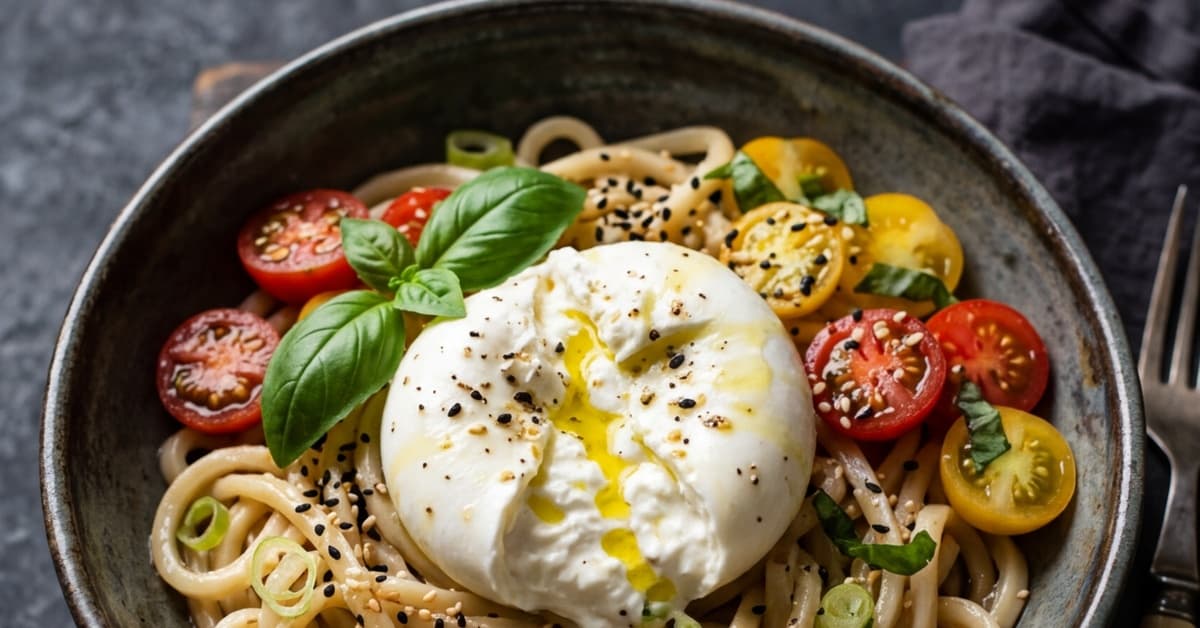
If you've never made real carbonara, here's the news that upsets people: there is no cream in it. There never was. The silk comes from egg yolk and hard cheese emulsified with a little starchy pasta water, whipped together off the heat so it turns glossy instead of scrambling. Master that one move and you can put it anywhere — including over a nest of ramen noodles, which is exactly what we're doing here.
This is the dish that opens Tokyo Meets Tuscany because it's the cleanest proof of the whole idea: Japanese and Italian cooking aren't opposites, they're two doors into the same room. Guanciale stands in for chashu — similar fat, different cure. Ramen noodles hold the sauce as well as spaghetti, arguably better, with more chew. A sheet of nori on top adds the faint sea note that ties the bowl together. Nothing here is a gimmick. Every swap earns its place.
Ingredients
Noodles
- 2 portions fresh or instant ramen noodles (discard the seasoning packet)
- Salt for the cooking water (less than for pasta — the cheese carries the salt)
Carbonara base
- 4 oz (115 g) guanciale, cut into small batons (pancetta works; bacon in a pinch)
- 3 large egg yolks + 1 whole egg
- ¾ cup (75 g) finely grated Pecorino Romano, plus more to finish
- 1 tsp freshly cracked black pepper, plus more
- ½ tsp soy sauce or a splash of dashi (optional — deepens the umami without announcing itself)
To finish
- 1 soft-boiled or onsen egg per bowl
- 1 sheet nori, cut into thin strips
- 1 scallion, thinly sliced
- Extra Pecorino and black pepper
Instructions
1. Render the guanciale. Put the batons in a cold, dry skillet over medium-low heat. Let the fat render slowly until the pieces are golden and crisp and the fat runs clear, about 6–8 minutes. Kill the heat. Leave the rendered fat in the pan — that's flavor.
2. Make the emulsion base. In a bowl, whisk the egg yolks, whole egg, grated Pecorino, and black pepper (and the soy or dashi if using) into a thick paste. It should look like wet sand.
3. Cook the noodles. Boil the ramen in lightly salted water until just shy of done — they keep cooking in the sauce. Reserve a full cup of the starchy cooking water before you drain. This is non-negotiable; it's what makes the sauce.
4. Combine off the heat. Add the drained noodles to the skillet with the guanciale and its fat. Toss to coat. Now take the pan completely off the heat and let it cool for 30–60 seconds. This is the whole game: too hot and you scramble the eggs into a grainy mess.
5. Emulsify. Pour the egg-cheese paste over the noodles and toss hard and fast, adding hot reserved pasta water a splash at a time. Keep tossing. In 30–45 seconds it transforms from clumpy to a glossy, clinging sauce. If it's tight, add more water; if it's loose, toss over the barest residual warmth for a few more seconds.
6. Plate and finish. Twirl into bowls. Top each with a soft egg, nori strips, scallion, a storm of black pepper, and more Pecorino. Eat immediately — carbonara waits for no one.
Why it works
Carbonara and ramen are built on the same physics: an emulsion of fat, protein, and starchy liquid that coats every strand. Pecorino brings glutamate — savory depth. The egg brings richness and the emulsifier (lecithin) that holds it all together. The starchy water is the bridge. Ramen noodles, made with alkaline kansui, have a springy chew that grips the sauce even better than spaghetti. The optional dashi or soy doesn't make it "taste Asian" — it stacks more umami onto a dish that's already an umami machine, the same way a splash of pasta water deepens any Italian sauce.
Tips
- No cream. Stop. If your sauce broke or feels thin, the fix is more cheese and more tossing, never cream.
- Temperature is everything. Off the heat, count to 30, then add the eggs.
- Salt light. Pecorino and guanciale are already salty — taste before adding any.
- Mise en place. This moves fast at the end. Have everything ready before you drain the noodles.
FAQ
Is there cream in carbonara? No. Authentic carbonara — and this ramen version — uses egg yolk, hard cheese, and starchy water to create its silky sauce. Cream changes the dish entirely.
Can I use bacon instead of guanciale? Yes, though guanciale (cured pork jowl) renders a cleaner fat. Pancetta is the closest swap; smoked bacon adds a flavor that's good but less authentic.
Why ramen noodles instead of spaghetti? The alkaline kansui noodle has more chew and grips the emulsified sauce beautifully. It's also what makes this a true Japanese-Italian fusion rather than just carbonara with a different noodle.
How do I keep the eggs from scrambling? Take the pan off the heat and let it drop 30–60 seconds before adding the egg mixture, then toss constantly while adding hot pasta water a splash at a time. Residual heat cooks the eggs gently into a sauce.
30 recipes and 6 master sauces in the book.
Get Tokyo Meets Tuscany on AmazonAs an Amazon Associate we earn from qualifying purchases. This is an affiliate link — it costs you nothing extra.
Paperback · Kindle
More free recipes