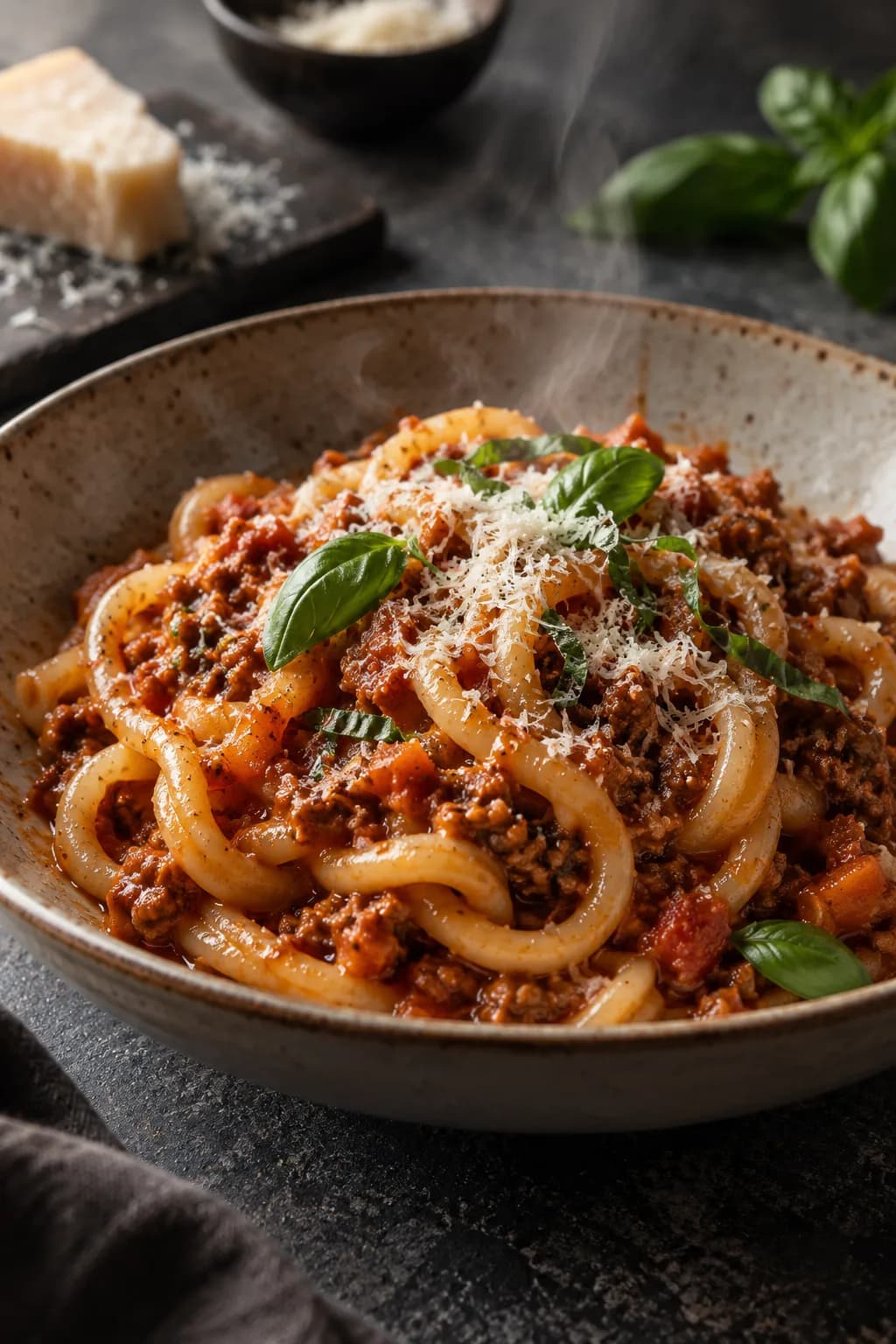
The Bolognese argument never ends: beef or pork, milk or no milk, tagliatelle or rigatoni. Italians have spent centuries on it. What nobody fought about, because nobody thought to try it, is udon. They should have.
Authentic Bolognese — the ragù alla Bolognese ratified by the Bologna Chamber of Commerce in 1982 — is a slow-cooked meat sauce made with soffritto, wine, a splash of milk, and very little tomato. It's dense, savory, and fatty in the best way. It coats flat, wide pasta because the width carries the sauce without competing with it. Udon noodles are flat, wide, and made from wheat. They carry the sauce. They work so well that after you try it, plain spaghetti feels like a mistake.
The fusion here is structural, not decorative. Nothing is added to make this feel "Japanese." There's no soy, no dashi, no ginger. The pork is just ground pork — not miso-cured, not anything. The udon earns its place because it is the right shape and the right texture, and because its mild, slightly sweet flavor lets the ragù dominate the way it was always supposed to.
Ingredients
Soffritto
- 1 medium yellow onion, finely minced
- 2 medium carrots, finely minced
- 2 stalks celery, finely minced
- 3 tbsp olive oil or unsalted butter
The ragù
- 8 oz (225 g) ground beef (80/20)
- 8 oz (225 g) ground pork
- ½ cup (120 ml) dry white wine (Pinot Grigio or Verdicchio)
- ½ cup (120 ml) whole milk
- ½ cup (120 ml) canned crushed tomatoes (not more — this is not a tomato sauce)
- 1 cup (240 ml) beef or chicken stock
- 1 bay leaf
- Kosher salt and black pepper
- Freshly grated Parmigiano-Reggiano, to finish
Noodles
- 4 portions fresh or frozen udon noodles (about 7 oz / 200 g per serving)
- Salt for the cooking water
Instructions
1. Build the soffritto. Warm the olive oil in a heavy-bottomed pot or Dutch oven over medium-low heat. Add the onion, carrot, and celery. Cook, stirring occasionally, until completely soft and lightly golden — about 15–20 minutes. Don't rush this. The soffritto is the foundation.
2. Brown the meat. Raise the heat to medium-high. Add the ground beef and pork in chunks. Season with salt and pepper. Cook, breaking it up, until the meat is browned and any liquid has evaporated, 8–10 minutes. The pan should be dry and sizzling before you proceed.
3. Add the wine. Pour in the white wine. Let it bubble hard, scraping up any brown bits, until the wine is almost completely evaporated — about 3 minutes. You should smell the alcohol cook off.
4. Add the milk. Pour in the whole milk and let it absorb into the meat on medium heat, stirring occasionally, until it's gone — about 5 minutes. This step is the secret: the milk tenderizes the meat and softens the acidity of the tomato.
5. Add tomato and stock. Stir in the crushed tomatoes and stock. Nestle in the bay leaf. Bring to a bare simmer — barely a few bubbles at the surface. Do not boil.
6. Slow-cook. Cook uncovered, stirring every 15–20 minutes, for a minimum of 1.5 hours (2 hours is better). The ragù is ready when the sauce is thick, the fat has risen and been stirred back in, and there is almost no liquid remaining. It should look like a loose, glossy meat mixture — not a soup.
7. Cook the udon. Boil the udon per package instructions. Fresh udon takes 2–3 minutes; frozen takes 4–5. Drain, reserving a cup of pasta water.
8. Combine and serve. Add the drained noodles directly to the ragù pot. Toss over low heat for 1–2 minutes, adding a splash of pasta water if needed to loosen. Serve immediately with a blizzard of Parmigiano-Reggiano.
Why it works
Bolognese is built on the Maillard reaction (browned meat), fat-carried flavor (pork fat and olive oil), and time (collagen from the meat breaks down into gelatin, giving the sauce its silky body). Udon is a wheat noodle made with salt and water — almost identical in composition to Italian pasta, just cut thicker and formed differently. That thickness is an advantage: it holds the dense ragù without getting lost in it. The mild, slightly elastic chew gives you something to bite into between rich, meaty mouthfuls. This is not the same dish as tagliatelle Bolognese, but it belongs in the same family.
Tips
- Mince the soffritto fine. You want it to dissolve into the sauce, not have visible chunks of onion or carrot. A food processor works.
- Don't skip the milk. It sounds strange but it's traditional and essential — the lactose sugars and fat round out the whole sauce.
- Go low and slow. If your ragù is boiling, it's going too fast. A bare simmer is correct.
- Make more. Bolognese freezes perfectly. Double the batch and freeze in portions.
FAQ
Is Bolognese a tomato sauce? No. Authentic Bolognese uses very little tomato — a few tablespoons, not a full can. The tomato is there for color and a touch of acidity, not flavor dominance. If yours tastes tomato-heavy, add more meat and milk.
Why udon instead of tagliatelle? Traditional Bolognese is served with flat, wide pasta (tagliatelle, pappardelle) because the width carries the meat without getting lost. Udon fills that role exactly — same width, comparable chew — while shifting the character of the dish.
Can I use dried udon? Fresh or frozen is strongly preferred. Dried udon tends to be thinner and softer. If that's all you have, undercook it by a minute so it holds up in the sauce.
How long does it keep? Refrigerated up to 4 days. Frozen up to 3 months. The flavor improves on day 2.
30 recipes and 6 master sauces in the book.
Get Tokyo Meets Tuscany on AmazonAs an Amazon Associate we earn from qualifying purchases. This is an affiliate link — it costs you nothing extra.
Paperback · Kindle
More free recipes